


Thermal imaging cameras, often perceived as futuristic gadgets from action movies, have quietly revolutionized countless industries and applications. Far beyond mere novelty, these sophisticated devices offer a window into a world invisible to the naked eye: the realm of heat. By detecting and visualizing infrared energy emitted by objects, thermal cameras translate temperature variations into detailed, readable images, making them indispensable tools for diagnostics, safety, and security.
This deep dive explores the underlying principles, diverse applications, and cutting-edge advancements in thermal technology, culminating in a look at how integrated systems, like the Wisualarm thermal camera, are setting new standards for comprehensive asset and life protection.
Understanding the Science: How Thermal Cameras Work
At its core, thermal imaging relies on the principle that everything with a temperature above absolute zero ($-273.15^\circ \text{C}$ or $0\text{ K}$) emits infrared radiation. This radiation is part of the electromagnetic spectrum but has a longer wavelength than visible light, making it imperceptible to the human eye.
A thermal imaging camera, or thermographic camera, is engineered to capture this energy.
The key components of a modern thermal camera include:
-
Optics: Special lenses (often made of materials like Germanium) focus the infrared energy emitted from the scene onto the detector. Unlike standard cameras, glass lenses cannot be used as glass blocks infrared radiation.
-
Detector (Microbolometer): This is the heart of the system. In most uncooled cameras (the most common type), the detector is a microbolometer—a grid of tiny sensors. When infrared energy hits a sensor, it slightly raises the sensor's temperature, causing a corresponding, measurable change in its electrical resistance.
-
Electronics and Signal Processing: Complex algorithms measure the change in resistance across thousands of microbolometer pixels. The camera then assigns a specific color or shade (typically from a visible color palette like ironbow or grayscale) to each temperature value.
-
Display: The processed data is projected onto a screen, creating a thermogram—a visual representation where hotter areas appear as brighter colors (e.g., red/yellow) and cooler areas as darker colors (e.g., blue/purple).
The resolution and thermal sensitivity (often expressed as Noise Equivalent Temperature Difference or NETD, measured in milliKelvins, $mK$) are critical metrics determining the camera's performance. A lower NETD value means the camera can distinguish between smaller temperature differences, offering a sharper and more detailed thermal image.
🌐 Diverse Applications Across Industries
Thermal cameras are no longer confined to military and firefighting use. Their ability to non-invasively detect heat signatures has made them essential tools across a vast range of sectors:
1. Predictive Maintenance (PdM)
In industrial settings, thermal cameras are used extensively for inspecting electrical systems, mechanical equipment, and piping.
-
Electrical: Loose connections, imbalanced loads, or faulty components generate excess resistance, leading to localized heating (a 'hot spot'). Identifying these hot spots early prevents catastrophic equipment failure, unscheduled downtime, and electrical fires.
-
Mechanical: Friction in bearings, couplings, or motors appears as heat, signaling impending mechanical wear before it becomes audible or visible.
2. Building Diagnostics and Energy Audits
Thermal cameras pinpoint hidden issues in building envelopes that lead to significant energy loss.
-
Insulation Gaps: Missing or water-damaged insulation shows up as cold spots on walls.
-
Air Leaks: Drafts around windows, doors, or wall penetrations appear as dark, cool streaks.
-
Moisture Intrusion: Evaporation from moisture-saturated materials cools the surface, allowing inspectors to trace the source of leaks and prevent mold growth.
3. Security and Surveillance
Unlike standard CCTV that requires visible light, thermal cameras work perfectly in complete darkness, fog, or smoke.
-
They detect the heat signature of intruders, animals, or vehicles, offering unparalleled perimeter detection regardless of lighting conditions.
-
They are highly effective at long ranges, as atmospheric obscurants have less impact on infrared wavelengths.
4. Firefighting and Public Safety
Thermal cameras are vital in search and rescue operations, enabling firefighters to navigate smoke-filled environments, locate fire victims, and identify the hottest parts of a structure to target water application.
💡 The Future is Integrated: Smart Thermal Surveillance
The next evolutionary step for thermal technology is its integration into comprehensive, connected safety and security ecosystems. Modern thermal cameras are transitioning from simple detection tools to intelligent, network-enabled devices capable of real-time analysis and interoperability with other safety systems.
This is where the Wisualarm Thermal Camera stands out, particularly through its groundbreaking focus on integrated fire safety.
Wisualarm: A Smarter Approach to Safety
The Wisualarm thermal camera is specifically designed to work as a sophisticated, always-on fire and asset monitoring solution. Its primary advantage is its ability to not only detect heat but to connect and cooperate with other critical safety devices, offering a superior level of protection compared to standalone systems.
Key Advantage: Seamless Interoperability with Smoke Detection
One of the most critical features of the Wisualarm system is the synchronized alarm function with its dedicated smoke detectors.
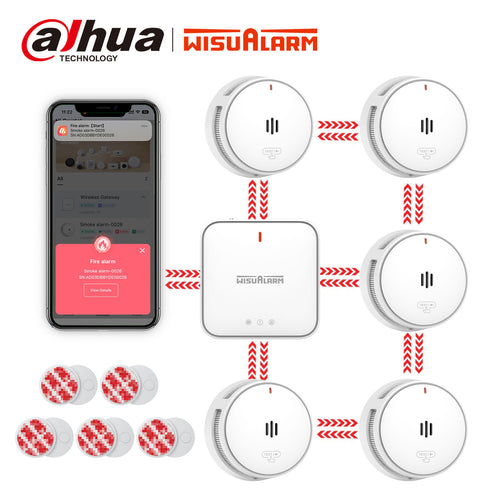
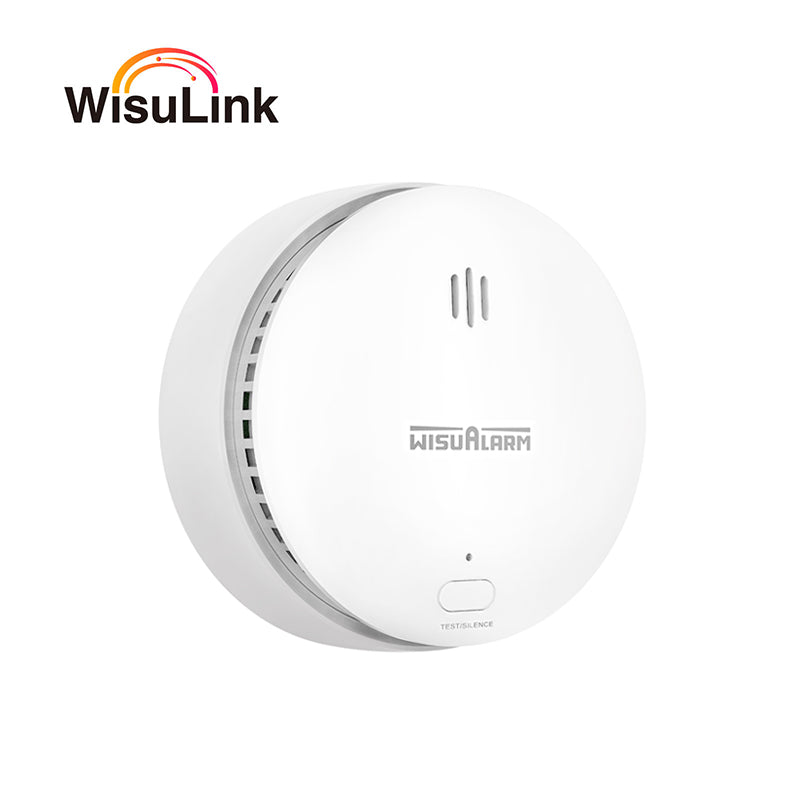
The camera and the Wisualarm Smoke Detectors are linked via the same system hub and the dedicated mobile application. When the Smoke Detector detects airborne particulate (smoke), it immediately triggers an alert. Simultaneously, the Wisualarm Thermal Camera is programmed to also initiate a corresponding alarm and capture visual confirmation. This dual-alert system ensures that an incipient fire is not only reported by a traditional sensor but also visually confirmed and temperature-monitored by the thermal camera.
This crucial linkage provides several benefits:
-
Redundancy and Verification: The smoke detector detects smoke; the thermal camera detects heat. In scenarios where a fire might start with smoldering heat without immediate smoke (e.g., electrical faults within a wall cavity), the thermal camera is the first line of defense. Conversely, the smoke detector confirms the presence of actual combustion. This redundancy minimizes false alarms while maximizing detection speed.
-
Contextual Alerting: When an alarm is triggered, the user receives an immediate push notification on the Wisualarm mobile app. The alert not only identifies the source (e.g., "Living Room Smoke Detector") but also provides the thermal camera's live feed and a thermogram snapshot, offering instant visual context of the threat and its severity (the actual temperature reading).
-
Targeted Response: By providing the exact location and thermal signature, the system enables users or emergency services to rapidly locate the source of the heat, even before a blaze is fully developed.
In essence, the Wisualarm thermal camera transforms into an intelligent, early-warning fire detection node that monitors for the precursors of fire (excessive heat) and collaborates with traditional detectors to provide a multi-layered, verifiable alert system accessible instantly on your smartphone.
Conclusion
Thermal imaging technology has progressed far beyond its early uses, becoming an essential tool for efficiency, diagnosis, and safety across every major industry. Its ability to quantify and visualize thermal energy provides a crucial layer of data that visible-light cameras simply cannot offer.
The future of thermal surveillance lies in smart, connected platforms. The Wisualarm Thermal Camera exemplifies this evolution, offering professional-grade thermal monitoring seamlessly integrated with established fire safety mechanisms. By combining high-definition thermal detection with the verifiable and instant alerting of a linked smoke detector system, Wisualarm provides a comprehensive, intelligent, and immediate solution for protecting property and securing peace of mind.
Upgrade your safety protocol. Stop waiting for the smoke to see the fire.