


Carbon monoxide (CO) is often called the "silent killer"—a colorless, odorless, and tasteless gas that can be fatal. It is a byproduct of incomplete combustion of carbon-containing fuels (like gas, oil, wood, and kerosene). Given its insidious nature, understanding where it accumulates in a room is crucial for effective prevention.
Does CO Sink or Rise? Clearing Up the Common Misconception
A widespread myth suggests that carbon monoxide, like carbon dioxide, sinks to the floor because it is heavier than air. This is inaccurate.
-
Molecular Density: Pure carbon monoxide ($CO$) has a molecular weight of approximately $28.01 \text{ g/mol}$, while the average molecular weight of dry air is approximately $28.97 \text{ g/mol}$. This means that pure CO is actually slightly lighter than air.
-
Thermal and Momentum Effects: In a real-world scenario, CO rarely escapes into a cool, still room. It is typically emitted from a heat source (like a furnace, water heater, or fireplace). The hot gases carrying the CO are buoyant and will initially rise, following the convection currents within the room.
-
Rapid Diffusion: Regardless of the initial buoyancy, the low concentration and rapid kinetic motion of gas molecules ensure that CO does not stratify (layer). It quickly mixes and diffuses throughout the air in the room, making the air quality dangerous at all levels.
Conclusion: CO does not settle exclusively on the floor or the ceiling. It contaminates the entire breathable airspace of the room, posing an equal threat to a person lying in bed, sitting in a chair, or standing up.
Strategic Placement for Maximum Protection
Since CO contaminates the entire room volume, the placement of a CO detector should be guided by two primary factors: proximity to sleeping areas and optimal detection range.
1. Near Sleeping Areas (The Priority)
The most critical placement is near where people sleep, as CO poisoning often occurs while occupants are unaware.
-
Install a detector on each level of your home.
-
Place one outside every separate sleeping area (e.g., in the hallway near bedrooms).
2. Near Potential Sources (The Secondary Check)
Though not a replacement for sleeping area protection, installing a detector near a potential source can provide an earlier warning.
-
Place a detector near the furnace, water heater, or fireplace.
-
Avoid placing the detector directly next to the source, as high heat or humidity could cause false alarms or damage the sensor.
3. Height Considerations for Installation
Standard safety organizations, such as the National Fire Protection Association (NFPA), recommend placing CO alarms:
-
On the wall or ceiling.
-
Following the manufacturer's instructions. (Some devices are tested specifically for ceiling, high-wall, or low-wall placement).
A good rule of thumb for wall-mounted detectors is to install them at least 5 feet (1.5 meters) off the floor to avoid interference from children or pets, but low enough to be easily accessible for testing and maintenance.
Take Control of Your Home's Safety with Wisualarm
Understanding where carbon monoxide accumulates confirms one truth: early detection is the only reliable defense. Since CO mixes throughout the entire living space, you need a detector that is accurate, reliable, and strategically placed.
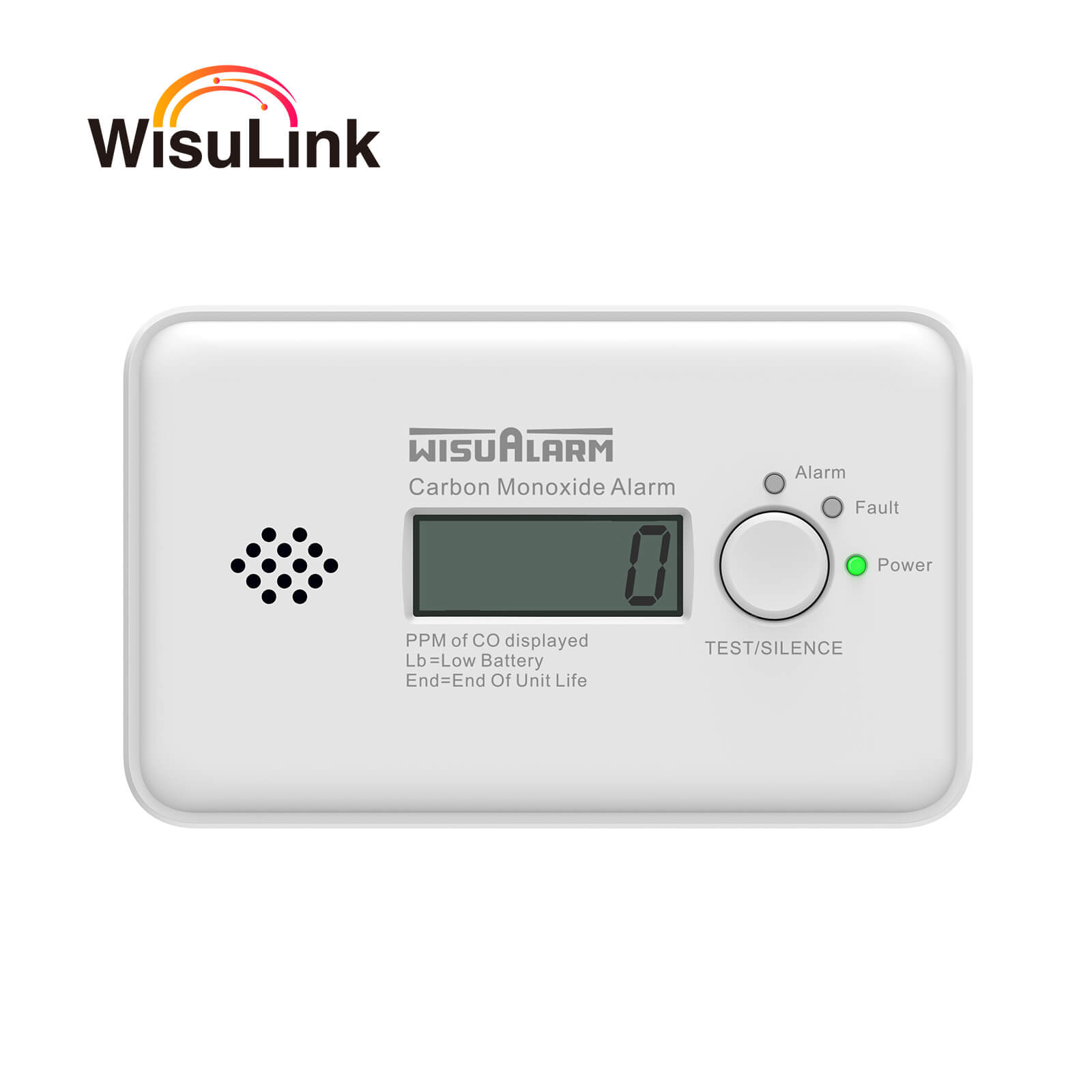
Introducing the Wisualarm Carbon Monoxide Detector.
-
Electrochemical Sensor Technology: Provides superior accuracy and longevity compared to older semiconductor sensors, minimizing false alarms while quickly detecting dangerous CO levels.
-
Digital Readout Display: Instantly shows the level of CO (in parts per million, or ppm) present in the room, allowing you to assess the severity of the threat.
-
Versatile Mounting: Designed to meet all safety standards, the Guardian Series can be easily mounted on walls or ceilings, ensuring optimal placement no matter your home’s layout.
-
Tamper-Proof Battery Backup: Continues to monitor CO levels even during a power outage, offering true 24/7 protection.
Don't wait for the invisible danger to strike. Protect your family with the proven technology of Wisualarm.