



The dream of "Van Life" has swept across Europe. From the rugged coastlines of Brittany to the snow-capped peaks of the Dolomites, more travelers than ever are trading hotel rooms for the freedom of a motorhome. But as we pack our gear and plan our routes, one invisible passenger often goes unnoticed: Carbon Monoxide (CO).
In the world of caravan safety, the term "3-in-1 gas detector" or "Gasmelder" is frequently thrown around. However, savvy European campers are shifting their focus. While propane leaks are loud and smelly, Carbon Monoxide is a ghost. It is the "Silent Killer" that claims lives every year in the camping community. This comprehensive guide explores why a dedicated, high-quality Carbon Monoxide detector is the single most important investment for your motorhome in 2026.
1. The Physics of the "Silent Killer": What is Carbon Monoxide?
To protect yourself, you must understand the enemy. Carbon Monoxide ($CO$) is a colorless, odorless, and tasteless gas. It is a byproduct of incomplete combustion. Unlike LPG (Propane/Butane), which has a distinct "rotten egg" smell added to it for safety, $CO$ gives no warning.
How it Kills
When you inhale $CO$, it enters your bloodstream and binds to hemoglobin—the molecule responsible for carrying oxygen. The terrifying part? $CO$ binds to hemoglobin 200 times more strongly than oxygen does.
In a confined space like a motorhome (often less than 15 square meters), $CO$ levels can reach lethal concentrations in minutes. You won't "wake up" because of the smell; instead, you will drift into a deeper, permanent sleep. This is why a electronic sensor is your only line of defense.
2. Why Motorhomes are High-Risk Environments
Modern European motorhomes (from brands like Hymer, Knaus, or Adria) are built to be incredibly airtight for thermal efficiency. While this keeps you warm in a Scandinavian winter, it also creates a "pressure cooker" environment if something goes wrong with your appliances.
Common CO Sources in a Van:
-
Faulty Diesel Heaters: Many DIY "Van Lifers" install budget diesel heaters. If the exhaust pipe develops a hairline crack or the seal fails, $CO$ is pumped directly into the living area.
-
Gas Refrigerators: Older Dometic or Thetford fridges use a small gas flame. If the flue becomes blocked by a spider web or soot, it begins producing $CO$.
-
Cooking Indoors: Using a gas hob for extended periods without proper ventilation (especially for heating the cabin—a dangerous but common practice) depletes oxygen and creates $CO$.
-
External Sources: If you are parked in a crowded campsite or a "Stellplatz" in Germany, the exhaust from a neighbor’s generator or engine can be sucked into your van through floor vents.
3. The "3 Gas" Myth vs. Carbon Monoxide Reality
Many campers look for a "3-way gas detector" (LPG, Narcotic, and CO). While these sound convenient, they often have a fatal flaw: Placement.
-
Propane (LPG) is heavier than air and sinks to the floor.
-
Carbon Monoxide (CO) is slightly lighter than air and mixes with warm air, rising to head height or the ceiling.
If you use a "combo" sensor plugged into a low 12V outlet to catch gas leaks, it may be too low to detect $CO$ before it reaches your lungs while you are sleeping in an elevated bed. This is why experts recommend a dedicated, battery-operated Carbon Monoxide detector mounted at eye level.
4. European Standards and Compliance: EN 50291
In Europe, not all detectors are created equal. When browsing platforms like Amazon.de or visiting a specialist shop like Reimo, you must look for the EN 50291 certification.
This European Standard ensures that the device has been tested to trigger an alarm at specific concentrations:
-
50 ppm: Alarm must sound within 60–90 minutes.
-
100 ppm: Alarm must sound within 10–40 minutes.
-
300 ppm: Alarm must sound within 3 minutes.
Cheap, unbranded sensors often fail these tests, either giving false alarms or, worse, remaining silent during a real leak.
5. Maintenance: The "10-Year Rule" for Van Life
Gas sensors are not like smoke alarms; they use a chemical reaction that eventually "wears out." Most high-quality $CO$ sensors have a lifespan of 7 to 10 years.
-
Dust and Humidity: Motorhomes experience extreme temperature swings—from -10°C in winter storage to 40°C in a summer sun. This stresses the internal components.
-
The Test Button: You should press the test button every time you start a new trip.
-
Battery Reliability: A dead battery in a $CO$ detector is a death sentence. This is why lithium-powered, long-life devices are the gold standard for the European market.
6. Case Study: The "Alpine Night" Scenario
Imagine you are wild-camping in the French Alps. To save battery, you run your gas heater all night. A heavy snowfall partially blocks the external ventilation flue. Inside, the flame begins to burn "yellow" instead of "blue," indicating incomplete combustion. Carbon Monoxide begins to fill the cabin.
Without a $CO$ detector, the occupants will experience a slight headache—often mistaken for altitude sickness or tiredness from driving. They go to sleep and never wake up.
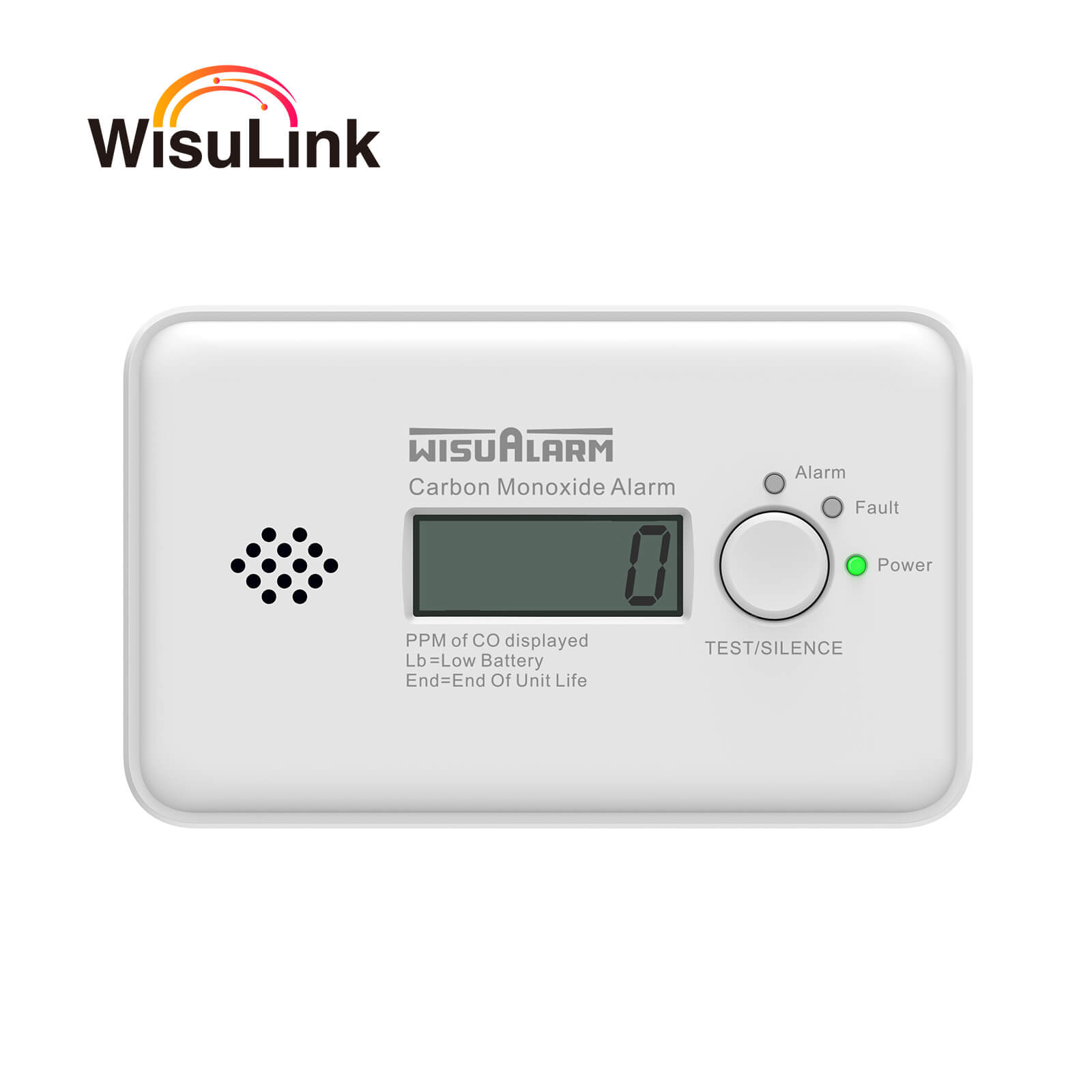
With a Wisualarm CO Detector, a piercing 85dB alarm would sound the moment levels hit 50ppm, giving the family plenty of time to open the door and step into the fresh mountain air.
7. The Ultimate Protection: Why Choose Wisualarm Carbon Monoxide Detectors?
When your life depends on a sensor, you need industrial-grade reliability. Wisualarm, a leader in smart security and fire safety, has engineered a Carbon Monoxide detector specifically designed to meet the rigors of the European domestic and leisure market.
What Makes Wisualarm the Best Choice for Your Motorhome?
1. Ultra-Precise Electrochemical Sensors:
Wisualarm uses the latest generation of electrochemical sensors. Unlike cheaper semi-conductor sensors that can be "fooled" by cooking Smells or cleaning sprays, our sensors only react to $CO$ molecules, ensuring zero false alarms and maximum accuracy.
2. 10-Year Long-Life Lithium Battery:
Forget about changing AA batteries every six months. Wisualarm detectors come with a built-in lithium battery designed to last for 10 years. This aligns perfectly with the lifespan of the sensor itself—once the battery is done, you simply replace the unit.
3. Large LCD Real-Time Display:
Most alarms only beep when it's too late. Wisualarm features a clear LCD screen that shows the current $CO$ concentration in Parts Per Million (PPM). Even if the levels are "low" (e.g., 20 PPM) and not yet dangerous, you can see the reading and investigate a potential leak before it becomes a crisis.
4. Compact & Aesthetic Design:
We know that every inch of wall space in a campervan is precious. Our detectors are sleek, modern, and compact. They blend into the interior of a luxury motorhome or a rugged DIY van build without looking like an industrial eyesore.
5. Rigorous EN 50291 Certification:
Every Wisualarm CO detector is built to exceed the European EN 50291 standard. We undergo strict quality control to ensure that when the "Silent Killer" enters your van, our alarm is the first thing you hear.
Conclusion: Don't Travel Without Peace of Mind
Your motorhome is your sanctuary on wheels. You've invested thousands in your vehicle and countless hours in your travel plans. Don't let a preventable tragedy end your journey.
Whether you call it a "Gasmelder," a "CO-Alarm," or a "Safety Essential," the reality is simple: You need a Wisualarm Carbon Monoxide Detector. It is the most affordable "insurance policy" you will ever buy for your family.